


Not Carved in Stone
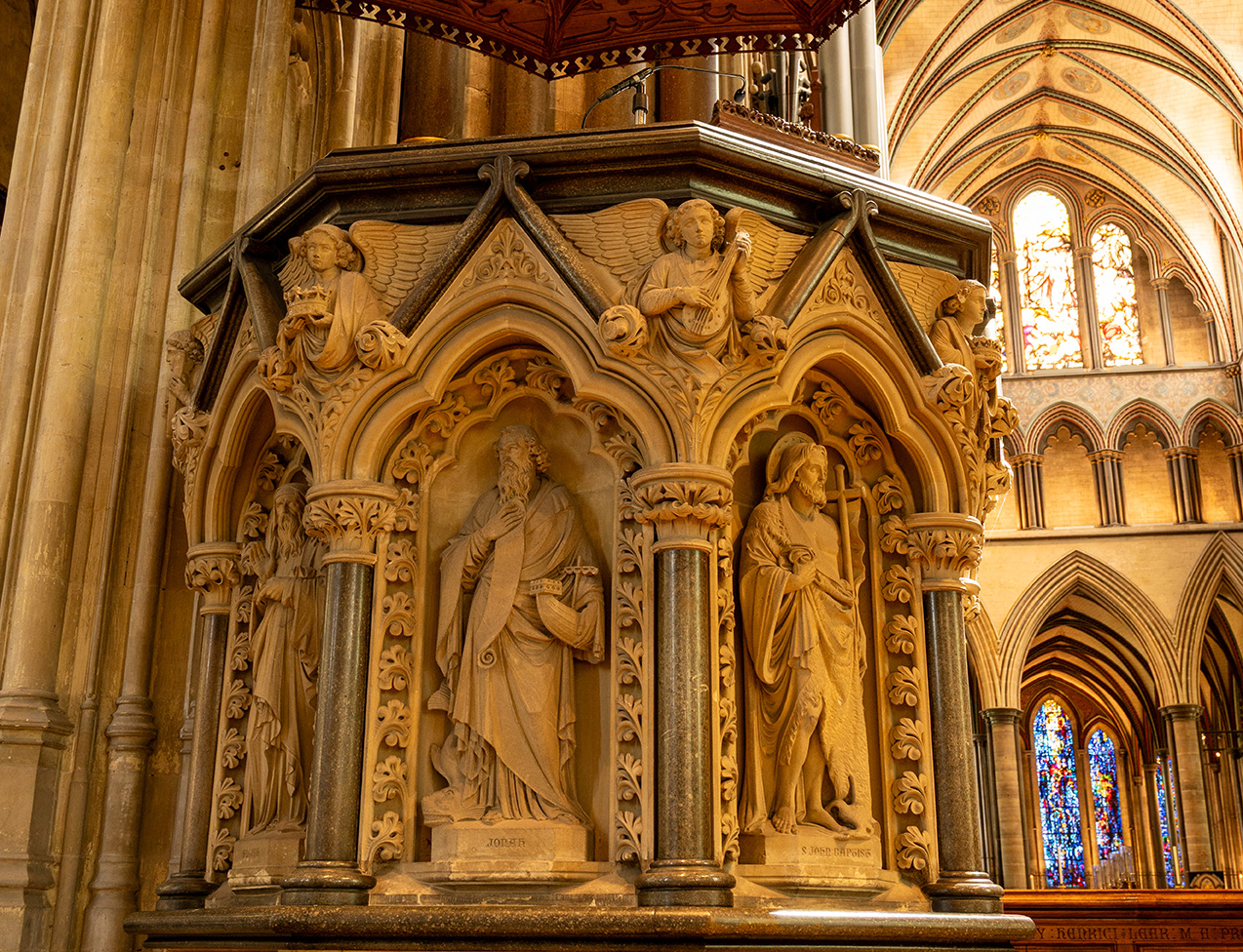
‘Not Carved in Stone’
A sermon by The Very Reverend Nicholas Papadopulos, Dean of Salisbury
Sunday 10 August 2025, 8th Sunday After Trinity
Isaiah 11: 10—end of 12
2 Corinthians 1: 1–22
Stone-carved statues of six Biblical figures ring our Spire Crossing pulpit. They are all men: three from the Hebrew Bible and three from the New Testament: Noah, Elijah, and Jonah; followed by John the Baptist, Saint Peter, and Saint Paul. They are a sharp reminder to any preacher who is encircled by them of his or her vocation to bear witness to the truth that the six have articulated in their various generations.
St Paul, the last of the six, is heavily bearded and dressed in a voluminous flowing robe. His gaze is upward and southward; his face is impassive. With his left hand he clutches a heavy, bound volume to his breast; the fingertips of his right hand rest upon the hilt of a sword. It’s a stylised portrait which betrays nothing of his character. That’s the point – of course – all six are bearded and robed, holy men of a common tradition, speaking of the God who has made himself known to Israel; while the book and the sword point to the history for which Saint Paul is known and celebrated. The book points to the teaching of his letters, the oldest surviving records of the Christian church. The sword points to his martyrdom, but it also, perhaps, recalls the battle the young Saul of Tarsus fought against the fledgling Jesus movement, the sharpness of his tongue in debate and disputation, and the tireless missionary campaign that he waged around the shores of the Mediterranean Sea.
So the statue does its job well. Set in stone, quite literally, is the Paul who many of us recognise. But the opening lines of his second letter to the Corinthians disclose a different Paul. ‘We do not want you to be unaware, brothers and sisters, of the affliction we experienced in Asia; for we were so utterly, unbearably crushed that we despaired of life itself’. As he writes, Paul is recovering from a searing episode which has plainly traumatised him deeply. We can only guess at what it was, but we know that in Asia – in Ephesus, to be precise – he had been held in prison, and we know that in the first century justice was arbitrary and cruel. What darkness did he endure; what torture did he suffer; into what hopelessness was he plunged; what nightmares does he continue to experience?
We cannot know, but these verses serve to remind us that Paul the teacher of doctrine, Paul the restless traveller, Paul who could be impatient and judgemental and even a little vain, Paul the name at the head of his letters – Paul is also one of us, our fellow human, not carved in stone, but made of flesh that could be bruised; not printed on a page, but made of blood that could run freely. And as we are reminded about Paul, so we are reminded about one another: reminded to look beyond the caricatures, beyond the reputations, beyond the post held, beyond the first impressions.
We are reminded, and we are reminded only because Paul chooses to tell us of his trauma (or tell his Corinthian readership). There is no façade of strength or pretence of invincibility. Paul chooses to tell his readers how he has suffered. He reveals his weakness and the temptation to despair to which he has fallen prey. We might call it ‘modelling vulnerability in leadership’. But Paul is not seeking sympathy or trying to make people like him more; this is not emotional manipulation of a sort with which we are familiar.
Paul speaks of his suffering because he has been delivered from it, and delivered from it by God. ‘He who rescued us from so deadly a peril’ he writes, ‘will continue to rescue us; on him have we set our hope’. The God who Paul proclaims – and to whom our six statues speak wordlessly – is the God who in Christ suffers in the world and with the world; the God who alone brings life out of death. ‘I am wounded’ writes Paul, ‘as you will be. And I am healed, as you will be’. In Christ, by Christ, through Christ. Amen.